Here we look at how the concept of the transmission immune system can explain the seasonality of airborne viruses in human populations in a typical temperate climate. In some regions air conditioning is likely to influence human behaviour as well as ventilation rates, in England and Wales these are uncommon in domestic environments.
Let’s consider data that charts annual viral cases over the course of the year. Source.
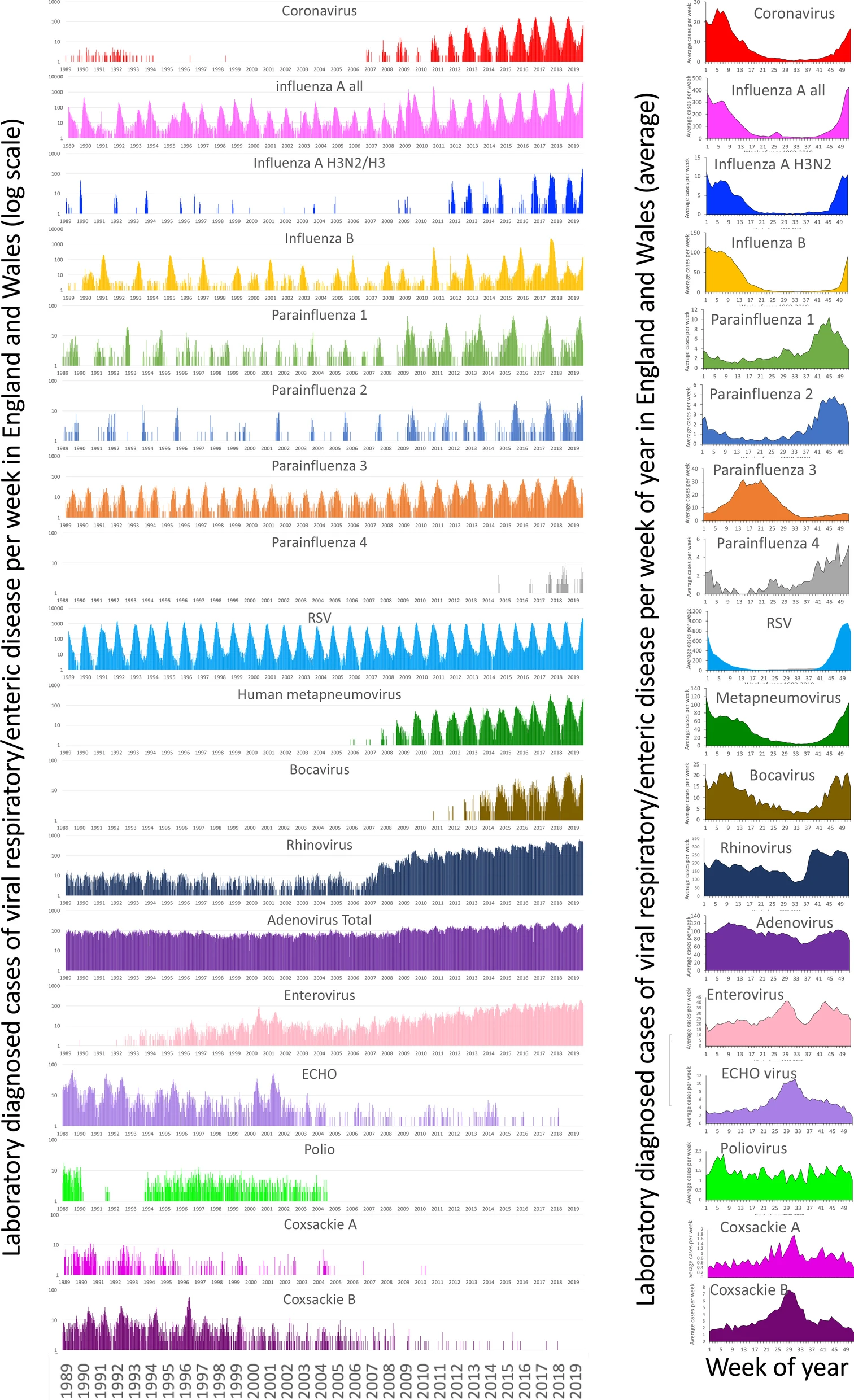
Noteworthy is that all respiratory viruses exhibit seasonality and that they generally become more transmissible in winter. The coronaviruses are not SARS-CoV-2, but the four common cold causing variants. Just from roughly scaling off the diagram, you can see a HUGE SEASONAL DIFFERENCE in transmissibility implied for SARS-CoV-2;

A number of explanations have been offered for the varying seasonal transmissibility in temperate climates of respiratory viruses in humans, including;
- Vitamin D deficiency – produced by skin in daylight and an important part of the immune system.
- Changing social behaviour – for example, people spending more time indoors as it becomes colder, closing windows.
What predictions do these make?
Vitamin D levels are at their lowest in late winter, so we would expect to see infection rates but Coxsackie A & B peak in the summer. This is impossible to explain, unless there’s something profound about how the immune system works that is currently unknown… …this seems unlikely.
Let’s consider changing social behaviour, like school term starts, closing windows, spending more time indoors. Again, while we can see this in data, it doesn’t explain the differing numbers for each virus type. They should begin to rise at the same time since the same phenomena are causing their rise, but peak at different times as it takes different lengths of time for people to become infectious. Neither is clearly demonstrated in the data.
Here we consider a novel idea, that transmissibility of respiratory viruses is not a unique property of the virus, but rather the result of the interaction between evaporating viral-laden mucus aerosols and the local environment.
As the aerosol evaporates the mucins and other antiviral constituents like lactoferrin would change concentration, which would impact the mucus’s general ability to prevent infection, but perhaps not in a linear predictable way, and perhaps not in exactly the same way for each virus, and perhaps would vary according to each person’s mucus (there will certainly be different types).
Because all viruses have differing sizes and capsids, the interaction between the transmission-preventing evaporating mucus would be different and unique to each virus. Also, because the different strains have slightly different capsids, there would be slightly different tranmissability between different strains of the same virus.
What about Coxsackie A and B, and echoviruses, these are peaking in the summer?
Well, these enter via the gastrointestinal route. If they are spread in a manner similar to respiratory viruses, then aerosolised mucus droplets do something to prevent respiratory virus infection as before, but the respiratory mucus is cleared and emptied into the gut. Any particles that you inhale ends up in your stomach, including aerosols containing coxsackie A and B, and echoviruses which specifically target this area as a means of infection. In fact, with summer conditions there is lower humidity and higher temperatures so we would expect virus-laden aerosols to shrink down to smaller, lighter nuclei, stay in the air longer, and a greater proportion to be inhaled. So they would become more infectious in the summer. Though this is just a hypothesis, it needs testing…
Several viruses like adenovirus appear to have as clear a relation between seasonality in England and Wales, and the average number of infections doesn’t vary as widely.
The exact relation between mucus and adenoviruses is unclear, but the ability to render viruses uninfectious probably varies substantially between virus type.